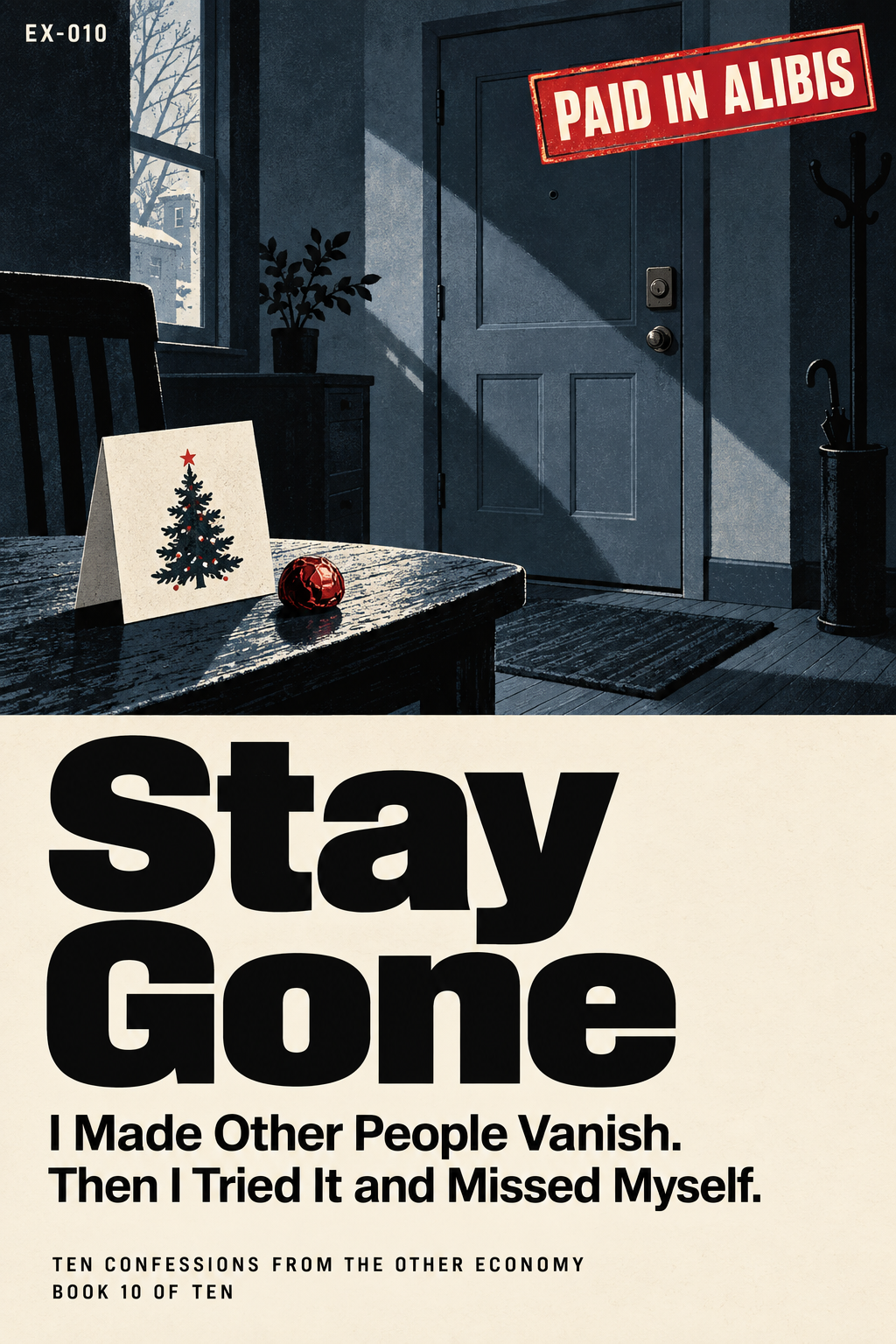
STAY GONE sounds like a skill. I kept the title because skills are what people come for, and because I am still willing to disappoint a customer. If you came for a trick, the trick is that there isn't one, and that I am arrogant enough to charge you a book for the disappointment. This is not a second copy of a killer's confession. I did not collect faces. I collected absences. If you came to learn how to vanish, the useful sentence is already over: face the music. The rest of these pages are what happens when a man does not.
I have three passports. Only one of them has my face. The other two have faces that look like mine if you squint — same jawline, different weather around the eyes, a nose that belongs to a cousin I never had. I keep them in a place I will not describe, in a city I will not name. I have not looked at them in two years. I do not need to. I know they are there. Knowing is not the same as using. Knowing is a kind of ache I have learned to live beside, the way you live beside a radiator that knocks and never quite heats the room.
The city has a river that does not get into the guidebooks. It is the color of tea left too long. On Wednesdays a market sets up on the near bank and sells onions, cheap batteries, and a cheese a woman cuts with a string. She does not ask your name. I have bought the cheese four times, then a fifth, then enough times that the count stopped being a count and became a weather I could stand in without becoming a regular. Regular is a word that requires a face the market can keep. I buy bread at a bakery two streets up where the loaves are too sweet and the girl behind the counter has stopped trying to remember me, which I count as a kindness I did not earn. There is a square with a statue whose plaque has been worn blank or stolen; I have never decided which. In November the rain arrives sideways and makes the stone look briefly expensive. I walk through it. Walking is the closest I come to a job.
I have learned the city's smaller hours because the larger ones still feel like a performance. At six the bakery puts out a tray that steams. At seven a man unlocks a kiosk and argues with a padlock that has always argued back. At eight the river takes whatever the night left — a bottle, a shoe, a plastic bag performing a kind of jellyfish. I have stood on the near bank and watched the bag and felt, against my will, a kinship I will not dignify with a metaphor. At nine I am often already tired of being a person who has nowhere to be. At ten I buy a coffee I do not finish. The cup has a name printed on it that is not a name a mother used. I throw the cup away before the name can become a habit the trash can describe.